
 I love teaching Russian to my students, but even when I am not in the classroom, many of my friends who do not speak Russian would ask me some to teach them some common Russian words and to teach them to read and write something in Russian (what their name would be written like in Russian, some words they already know, etc).
Lots of them, especially English and French-speaking ones, were surprised by how easy it was to read Russian once I showed them the method I developed in my classes. That method alongside with many other little tricks and simplified ways of teaching Russian that I have developed became the basis for my Russian Step By Step Series.
If you do not speak a language that uses the Cyrillic alphabet, Russian letters might seem to you like an odd combination of the Latin letters and other weird signs. I have taught a lot of speakers of English (as their first language) and noticed a pattern of mistakes the students were making while learning to read Russian. So I divided the alphabet into several groups of letters, to make it easier to memorize and to help avoid confusion.
 Some of the letters are really easy because they look very similar to the English ones and make similar sounds: A, O, T, E, K, and C. Some of them look different but make similar sounds: Б, Г, Д, Ё, Ч, Ж, И. Some of them look different and are pronounced differently: Щ, Ы, Ц. And some of them look similar but make different sounds: Р, Н, В, Х.
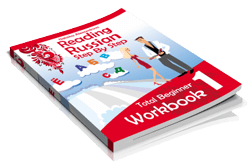
By using some principles that teachers of Russian use to teach kids how to read in Russia and adding my observation about the 4 different groups of letters, I created exercises that use simple constructions and vocabulary and help remember how to read words, phrases, sentences in Russian from the very first lesson. Reading Russian Workbook is now one of the most popular books in our series.
 As handwriting is very important in Russia, I created a supporting material called Russian Handwriting (Propisi) that consists of three volumes. Volume 1 introduces the same letters as Reading Russian and can be used together with the book, as well as independently. Volumes 2 and three allow for more complex practice and introduce additional vocabulary and rules.
I had a lot of feedback from students and teachers alike (and made some revisions to the books thanks to some of them), but I am always really touched when teachers write to me to tell me how much their students love the book and how much they, the teachers, appreciate it.
One of the teachers, teacher Alyona, has recorded several videos of her classes where she uses our materials and I am happy to share them with you.
In this video, she goes into helpful tips on how to connect your letters when using the Russian Handwriting.

Please send any feedback to info@russianstepbystep.com or like our Facebook page and message us any time! My team and I love talking to our audience.
 Reading Russian Workbook: Russian Step By Step Total Beginner (Book & Audio) [Kindle Edition]
Get it on KINDLE! If you don’t have a Kindle, you can download in for Free!
This blog post is written by Natasha Alexandrova and edited by Anna Watt